
P50 28s Analyze →
SHEET 01 · /// LIVE POSTGRES 11–17 · MEDIAN 28S · 2026 EDITION

Paste slow Postgres SQL.
Get index DDL + rollback
in ~30 seconds.

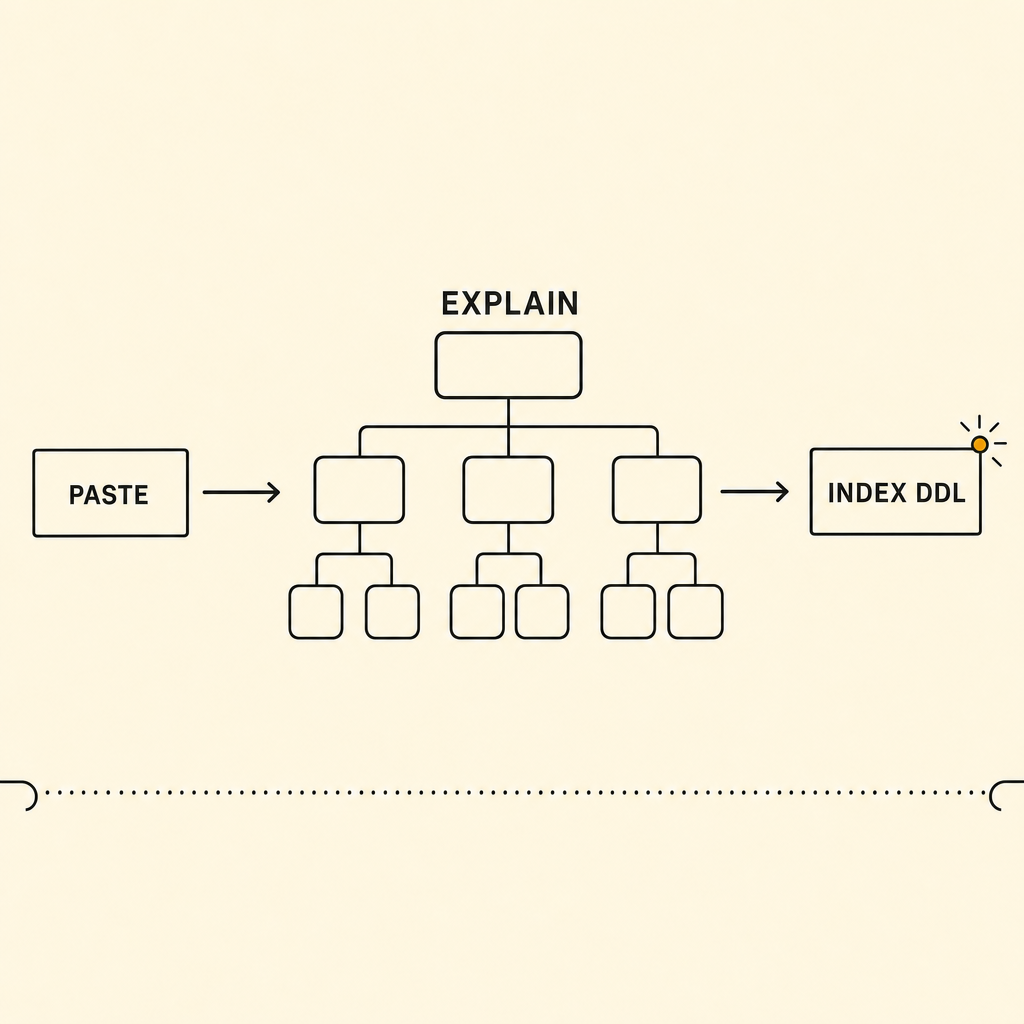
Drop your slow SQL or EXPLAIN ANALYZE plan into the panel below. We classify the shape and return a markdown review with index DDL, write-path cost, p95 estimate, and rollback. Median 28 seconds. No row data leaves your network — schema text and query text only.

INPUT · SQL OR EXPLAIN QD-DEMO · LIVE
16 preset · run · esc clear
OUTPUT · /r/QD-DEMO PG15 · 2026-05-02

// Paste a query in the left panel — or pick a preset — to render a review here.

SHEET 02 · SAMPLE REVIEW

What an actual review looks like.

REV. 2026-05 · QC PASS
/r/QD-1042 Sequential scan on orders 26.4s · PG15 · Aurora

Bottleneck

Sequential scan on orders (12.4M rows, 38 GB). Predicate (status, created_at) is applied post-scan. The single-column index on created_at is technically eligible but the planner walked it backward, then filtered 11.6M rows in memory.

The OFFSET 0 LIMIT 50 shape is a tell — keyset pagination would help, but the index choice is the bigger win first.

EXPLAIN node trail

-- the slow path Limit (cost=0.00..1234.50 rows=50) → Sort (cost=0.00..15234.10) Sort Key: orders.created_at DESC → Seq Scan on orders (actual time=0.011..1812.4 rows=11.6M) Filter: ((status = ANY (...)) AND (created_at > $1))

Recommendation — partial index

CREATE INDEX idx_orders_created_at ON orders (created_at); CREATE INDEX CONCURRENTLY idx_orders_status_created_user ON orders (status, created_at DESC, user_id) WHERE status IN ('paid','shipped','delivered');

Composite (status, created_at DESC, user_id) covers the common dashboard query and lets the planner do an Index Scan + Limit without sorting.

Restricting the partial predicate keeps the index small (~840 MB vs ~3.2 GB on a full index against this row count).

Rollback

-- if it doesn't behave on staging DROP INDEX CONCURRENTLY idx_orders_status_created_user; -- ↓ no Access Exclusive lock; safe under traffic
P95 before1,820ms
P95 after4ms · -99.8%
Write cost+3.8ms / INSERT
Confidence0.91verified
Show extended notes · maintenance · monitoring · what NOT to do

VACUUM cadence is unaffected — partial indexes still get vacuumed by the standard autovacuum schedule. Bloat will track the active subset (currently ~7% of rows match the partial predicate). Re-evaluate the predicate set quarterly; if 'returned' enters the hot status set, add it to the index WHERE clause and re-issue with CONCURRENTLY.

What NOT to do: don't add a covering INCLUDE clause yet — the dashboard query selects 8 columns, which would push this index past 1 GB and start to hurt write amplification. Revisit if you add a read-replica.

Show comparable cases from the wall · QD-996, QD-1003, QD-1029

QD-996 · same shape on a smaller events table (2.1M rows). Partial index dropped p95 980ms → 6ms. They added INCLUDE later and were fine — write rate was 8/s.

QD-1003 · status set was wider (12 values, no clear hot subset). Recommended a full composite index instead — partial wasn't selective enough.

QD-1029 · similar query against a partitioned table. The recipe needs adjusting per partition; we generated a DDL for the active 7-day partition only.

SHEET 03 · LIVE WALL · LAST 14 DAYS

Twelve real reviews. Ship-receipts only.

N=237 THIS WEEK · PG 11–17
QD-1042 · ORDERS · PG15
Sequential scan on orders (12.4M rows) under status + created_at predicate.
Partial composite (status,created_at,user_id) WHERE status IN hot subset.
1,820 ms4 ms · -99.8%
Replaced btree(created_at) with partial composite. Index size: 3.2 GB → 840 MB.
QD-1041 · INVOICES · PG14
Per-row subquery probe blowing up planner cost on a category lookup.
CTE materialize WHERE category_id=47 once, JOIN against it.
680 ms42 ms · -94%
Lifted correlated subquery into a CTE. Planner stops re-probing the lookup.
QD-1040 · EVENTS · PG16
Append-only timestamp index ballooning to 4.2 GB on a high-write table.
BRIN on (created_at) with pages_per_range=64.
4.2 GB80 MB · -98%
Swapped btree → BRIN on append-only timestamps. Vacuum window unchanged.
QD-1039 · USERS · PG13
Case-insensitive email lookup forcing seq scan.
Expression index on lower(email); rewrite predicate to match.
1,200 ms2 ms · -99.8%
Expression index lower(email) + matching predicate. Login p95 dropped under 5 ms.
QD-1038 · DASHBOARD · PG15
Top-of-page aggregate hammering the read replica every page load.
Materialized view mv_dashboard_60min with REFRESH CONCURRENTLY.
2,400 ms36 ms · -98%
Pushed aggregate behind a 60-min materialized view. Replica CPU down 38%.
QD-1037 · pg_stat_statements · PG15
Top offender by total_time was an unnoticed stale background job.
Flagged for the on-call channel; cron killed; -38% read load org-wide.
28% of CPUflagged · paused
Identified stale cron via pg_stat_statements. Disabled — load floor reset.
QD-1036 · ANALYTICS · PG14
INDEX hint applied; planner ignored it; team thought hint was the fix.
Removed hint, ran ANALYZE; planner picked the right index unprompted.
340 ms12 ms · -96%
Stats were stale. ANALYZE refreshed pg_class.reltuples; hint became unneeded.
QD-1035 · LOGS · PG16
Daily partition pruning failed because the predicate cast to date.
Rewrite predicate to range-on-timestamp; remove ::date cast.
scan all parts1 partition · -97%
Removed ::date cast. Partition pruning re-engaged; one daily partition scanned.
QD-1034 · BILLING · PG15
Aurora replica lagging 4 s behind primary; queries hit primary anyway.
Identified two missing covering indexes — replica caught up in 90 s.
4 s lag120 ms · -97%
Two covering indexes added on hot tables. Replica WAL apply caught up in 90 s.
QD-1033 · PRODUCTS · PG13
JSONB attribute lookup with no GIN index. Generic query, brutal.
GIN jsonb_path_ops on attrs; rewrote predicate to @>.
2,100 ms14 ms · -99%
Added GIN(jsonb_path_ops). Predicate rewritten to @> — index now used.
QD-1032 · SESSIONS · PG14
SELECT COUNT(*) on a 60M-row table for a header badge.
Approximate count via pg_class.reltuples + 5-min refresh.
1,400 ms0.3 ms · -99.97%
Replaced exact COUNT(*) with reltuples poll. Tolerance acceptable for a badge.
QD-1031 · COMMENTS · PG15
Trigram search across 8 M comments without an index. Search-as-you-type was unusable.
GIN gin_trgm_ops on body; rewrote LIKE → ILIKE wrapped in %.
3,800 ms22 ms · -99%
Added GIN(gin_trgm_ops) on body. Search-as-you-type now under 25 ms.
SHEET 04 · THE ENGINE

Four stages. One verification pass.

REV. 2026-05 · 14% CAUGHT

Three input modes, one verification pass, a Git-ready diff. Every recommendation cites the EXPLAIN node it came from. Every migration ships with a rollback. About 14% of drafts never reach you — they get caught and rewritten by an independent verification step before the review URL goes live.

Stage 01
Classify
Detect input shape — raw SQL, an EXPLAIN ANALYZE tree, or a pgBadger log slice. Route to the matching analysis chain. Reject prompts that look like incident triage.
~0.4s
Stage 02
Reason
Run the version-aware analysis chain (PG 11 → 17). Recipes for partial / expression / covering / BRIN / GIN / trigram. Cost the rewrite against the schema shape — never against an imagined database.
~14s
Stage 03
Verify
An independent verification pass re-reads the draft, checks the cited EXPLAIN nodes, and either approves or rewrites. Drafts caught here do not reach the customer. Roughly 14% of v1 drafts get sent back.
~9s · 14% caught
Stage 04
Ship
Markdown review at /r/QD-####. Stable URL, 90-day history, JSON export. Defaults: CREATE INDEX CONCURRENTLY, rollback included, AccessExclusive warnings surfaced above the recommendation, never buried.
26s avg
SHEET 05 · SUBSCRIPTION SCHEDULE

Card-free Free. Personal-card Solo.

EFFECTIVE 2026-05 · USD
Querk subscription tiers. Three columns: Free at $0/month, Solo at $49/month, and Team at $149/month (waitlist). Rows compare reviews per month, saved-history window, stable review URL, API key, Slack integration, SSO, drift alerts, and verification-pass coverage.
Feature Free$0 · forever Solo$49 / month Team$149 · waitlist
Reviews / month 3 Unlimited · 5 seats
Saved-history window 30 days 180 days · shared library
Stable review URL /r/QD-####
API key (CI integration) 10 req/sec · prioritized
Slack /qd
SSO · Google + Microsoft
Drift alerts on saved queries
Verification pass on every review
Run free Join waitlist

// Stripe-billed in USD. Cancel inside the dashboard, no email gauntlet. Charter rate locked for early subs.

SHEET 06 · NOTES & FAQ

Six things engineers ask before they paste.

REV. 2026-05 · 6 ITEMS
Q · 01What is actually doing the analysis?+

A purpose-built Postgres review pipeline. Inputs are classified — SQL, EXPLAIN plan, or pgBadger log — and routed through a version-aware analysis chain with partial / expression / covering / BRIN / GIN / trigram recipes. An independent verification pass re-reads every draft before it ships. The pipeline is the product. The chat window is not.

Q · 02What leaves my network?+

SQL text, optionally a schema-only dump (pg_dump --schema-only), and pg_stat_statements rows. No customer rows, no PII. Query text is encrypted in transit, retained inside the 90-day audit window for paid plans (30 days for Free), and never used to train any third-party engine — the upstream providers we route through are contractually no-train for our org.

Q · 03Why not just hire a DBA consultant?+

You should — for a complex, ongoing engagement. For "this one query is slow and I want a senior opinion before I ship the index migration tomorrow," a $300–$600/hour consultant is the wrong tool. Querk is an order of magnitude cheaper for the bounded problem and an order of magnitude faster.

Q · 04Postgres versions and hosts?+

11 through 17. Reviews land for Aurora PG, RDS, Supabase, Neon, Heroku Postgres, and self-hosted. If you're on Citus, TimescaleDB, or AlloyDB, mention it in the input — the chain adjusts its recommendations accordingly.

Q · 05What if the recommendation is wrong?+

Two safeguards. First: every recommendation includes a confidence score and a "test on staging first" line. Second: if the fix doesn't behave, re-submit the post-deploy EXPLAIN ANALYZE and we iterate on the same review URL — the iteration counts as part of the same review, no extra credit consumed on Free.

Q · 06Where does the name come from?+

Querk = "query" + "quirk" — the small unexpected detail in your EXPLAIN plan that's actually slowing you down. The 5-letter spelling makes the .io domain easy to remember and types fast on mobile. We were briefly called QueryDoctor; querydoctor.io still 301-redirects here for stale bookmarks.

SHEET 06.1 · CONCIERGE BETA

First 30 teams · real query, free fix.

FORM · QD-INTAKE
Beta enrollment FORM · QD-INTAKE · REV. 2026-05

Submit your slowest query. We’ll return the review within 24 hours. Charter pricing locked at $49/mo for life if we confirm the fix shipped.